
'The country is a good test bed for enterprise adoption, but to scale rapidly, companies will need to look outside the country for customers.'

Prime Minister Narendra Modi on Tuesday met Microsoft co-founder and billionaire philanthropist Bill Gates on the sidelines of the climate summit here and discussed ways to further sustainable development, steps to mitigate climate change and vaccine research. The meeting between Modi and the American business magnate, whose foundation is focusing on fighting the COVID-19 pandemic, took place after the former launched the Initiative for the Resilient Island States (IRIS) for developing infrastructure of small island nations. Prime Minister Modi expressed appreciation for the work being done by the Bill and Melinda Gates Foundation in India, the Ministry of External Affairs (MEA) said in a statement.
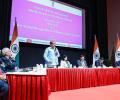
JD-U MP Sanjay Kumar Jha heads a diplomatic mission to Indonesia, Malaysia, South Korea, Japan and Singapore, to seek international cooperation after the Pahalgam attack while highlighting Pakistan's role in cross-border terrorism.

Scientists expect to get new information about the past, present and future of the Sun after analysing the data that will be collected by India's first solar mission Aditya-L1, scheduled to be launched by Indian Space Research Organisation (ISRO) on September 2.
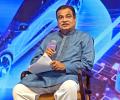
'I am not an aspiration-oriented politician.' 'This is the time to redefine politics.' 'Politics of power is not real politics.'
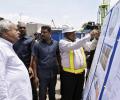
The metro, it seems, is politics-proof -- even if it comes at a high cost.
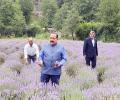
From using lavender in traditional Dogri embroidery to making essential oils, beauty products and food syrups infused with this flowering plant, Bhaderwah, once known for its maize fields, is embracing lavender to bring about an economic transformation to their small town.
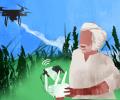
The Centre on Monday announced seven big programmes for the holistic growth of agriculture and allied sectors with a total outlay of nearly Rs 14,000 crore, as it aims to improve farmers' income. The Union Cabinet approved seven big-ticket programmes related to the farm sector, including a Rs 2,817-crore digital agriculture mission and a Rs 3,979-crore scheme for crop science. "The Union Cabinet, chaired by Prime Minister Narendra Modi, approved seven schemes to improve farmers' lives and increase their incomes at a total outlay of Rs 13,966 crore," an official statement said.
The ministry of home affairs has suspended the Foreign Contribution Regulation Act (FCRA) licence of prominent public think-tank Centre for Policy Research (CPR) over violation of laws, officials said on Thursday.

'Geopolitical stability could remove the crude oil risk premium.'

He said scientists have noticed a trend of very deep cloud systems developing over the southeast Arabian Sea, and added that sometimes, these systems intrude into the land, like in 2019.

Finance Minister Nirmala Sitharaman on Tuesday announced nine priorities in the Union Budget 2024-25 for generating ample opportunities in the economy. The nine priorities include productivity, jobs, social justice, urban development, energy security, infrastructure, innovation and reforms.

'Pick up momentum and find opportunities from an intelligence-sharing standpoint.'

Research using NASA satellite images has revealed a concerning retreat of snow cover atop Mount Everest, indicating a lack of snow accumulation during the winter season of 2024-2025. This trend, observed through a 'rising snow line', suggests a warming climate and warmer, drier conditions prevailing in recent winters. Glaciologist Mauri Pelto attributes the snow cover loss to sublimation, where ice directly evaporates, contributing to the retreat of glaciers even above 6,000 meters on Mount Everest.
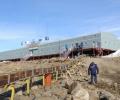
Amid protests by Opposition members seeking a debate on price rise, the Lok Sabha on Friday passed the Indian Antarctic Bill, 2022, which seeks to extend the application of domestic laws to research stations set up by India in the Antarctic region.
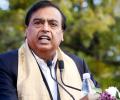
'You must be good at using AI as a tool of learning but do not give up your own critical thinking.'
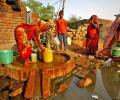
The water crisis could jeopardise more than half of the world's food production and cause an average global GDP loss of 8 per cent by 2050, with lower-income countries facing up to a 15 per cent loss, according to a new report.

Naval assets take years to build, and therefore, not only is futuristic force planning essential, but indigenous projects must also be put into the pipeline, technologies developed and contracts for assets signed regularly so that the Indian Navy always remains a future-focussed force, asserts Vice Admiral Biswajit Dasgupta (retd).

Akanksha Mary Balmuchu from Jharkhand's Ho tribe is starting a Master's programme in climate change in the UK. When she walks into campus, she fulfils not only her dream, but that of her grandmother.

President Trump originally announced his intention to withdraw from the agreement in 2017 and formally notified the United Nations last year. The US exited the pact after a mandatory year-long waiting period that ended on Wednesday.

Finance Minister Nirmala Sitharaman on Saturday announced six new schemes and increased the subsidised Kisan Credit Card (KCC) loan limit to Rs 7 lakh from Rs 5 lakh, targeting everything from unemployment to crop productivity enhancement across the country. Presenting her eighth budget speech in Parliament, Sitharaman positioned agriculture as "the first engine of growth" and unveiled the Prime Minister Dhan-Dhaanya Krishi Yojana, a flagship program targeting 100 agri-districts grappling with low productivity, moderate crop intensity, and below-average credit parameters.

The independent group of scientists and communicators previously said that winters are quickly transitioning into summer-like conditions in north India, shortening the spring season.

Asserting that India's dedication to climate commitments is evident from its performance, Prime Minister Narendra Modi on Monday hoped that rich countries of G-7 will support India's efforts in combating climate change and invited them to tap the huge market for clean energy technologies emerging in the country. In his remarks at the session on 'Investing in a better Future: Climate, Energy, Health' at G7 Summit, Modi highlighted India's track record and said it has achieved the target of 40 per cent energy-capacity from non-fossil sources nine years before time. "The target of 10 per cent ethanol-blending in petrol has been achieved 5 months before time.
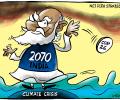
Three years after India declared its goal to become a net-zero economy by 2070, the policy design for achieving the target has begun, with the NITI Aayog forming dedicated multi-sectoral committees to prepare a transition plan. In 2021, India joined a select group of nations that set a target year for becoming net-zero carbon economy. At COP26 in Glasgow, Prime Minister Narendra Modi outlined a five-pronged 'Panchamitra' climate action target for India and committed to a net-zero target by 2070, joining nations like the US, the UK, and China.

The analysis revealed abrupt changes in temperatures occurring in late winter across north India.
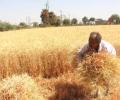
A report authored by UN's panel of scientists from across the world on climate change and sent to the governments of 197 countries has ominous news on the climate change front.
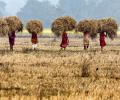
In a significant policy shift aimed at boosting agri-productivity and rural prosperity, Finance Minister Nirmala Sitharaman on Saturday announced six new agricultural schemes while increasing the subsidised Kisan Credit Card loan limit to Rs 5 lakh from the existing Rs 3 lakh, benefiting 7.7 crore farmers, fishermen, and dairy farmers.

'Everything about farming is enjoyable and relaxing.'

The Australian Conservation Foundation's Climate Change Program Manager Gavan McFadzean also said athletes need to step up.
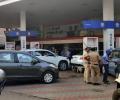
The Delhi government has announced that vehicles older than 15 years will be denied fuel at petrol pumps starting April 1.

Presenting the Union Budget, Sitharaman announced that the government will partner with the private sector to set up Bharat Small Reactors and in the research and development of small modular reactors.

India cannot ignore the neglect of climate finance by the developed nations, Modi asserted at G20 session

Apart from the human body, human food will bear direct repercussions. From staples such as wheat, to coffee, dairy, and even the great Hilsa face the threat of reduced supply due to the extreme heat.

'The first and most basic responsibility of any government is to protect its people from external threats and internal harm.' 'Budget 2025-2026 has to focus on meeting this responsibility,' asserts R Jagannathan.

The Royal Swedish Academy of Sciences on Monday has decided to award the 2024 Nobel Prize also known as the Sveriges Riksbank Prize in Economic Sciences to Daron Acemoglu, Simon Johnson and James A. Robinson "for studies of how institutions are formed and affect prosperity."

Air quality index (AQI) soared past 350 level in parts of Delhi on Thursday and experts cautioned that as weather turns colder it may breach the 400-mark ceiling and enter the 'severe' zone soon, notwithstanding the incidents of stubble burnings which have nosedived from 17,529 in 2020 to 4,262 this year.

Climate and sustainable development financing, multilateral institution reforms, regulation of digital assets, the spillover effect on developing economies from actions of western central banks, energy and food security in the backdrop of war in Europe, and sanctions on Russia and their impact on the global economy are some of the agenda items that India will take up as President of G-20, Finance Minister Nirmala Sitharaman said on Tuesday. India will take over as President of the powerful international grouping on December 1 for a year. There will be around 200 meetings throughout the country, with the summit Heads of State meeting expected to be held in New Delhi next September.
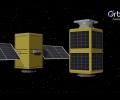
'It is our duty to keep space sustainable and free of debris.'

That climate change will impact Indian agriculture is a foregone conclusion. In what way precisely is not clear, though some clues are emerging through various research projects to capture these signals and assess their impact on crops, livestock, fisheries and other fields.
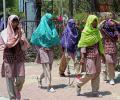
The global body added that national meteorological and hydrological departments in both countries are working closely with health and disaster management agencies to roll out heat health action plans.
